
Iron Bull Trailers
Iron Bull DTB Dump Trailer Review: Uses, Pros, Cons, and Best Sizes
Apr
Introduction: What Is the Iron Bull DTB Dump Trailer?
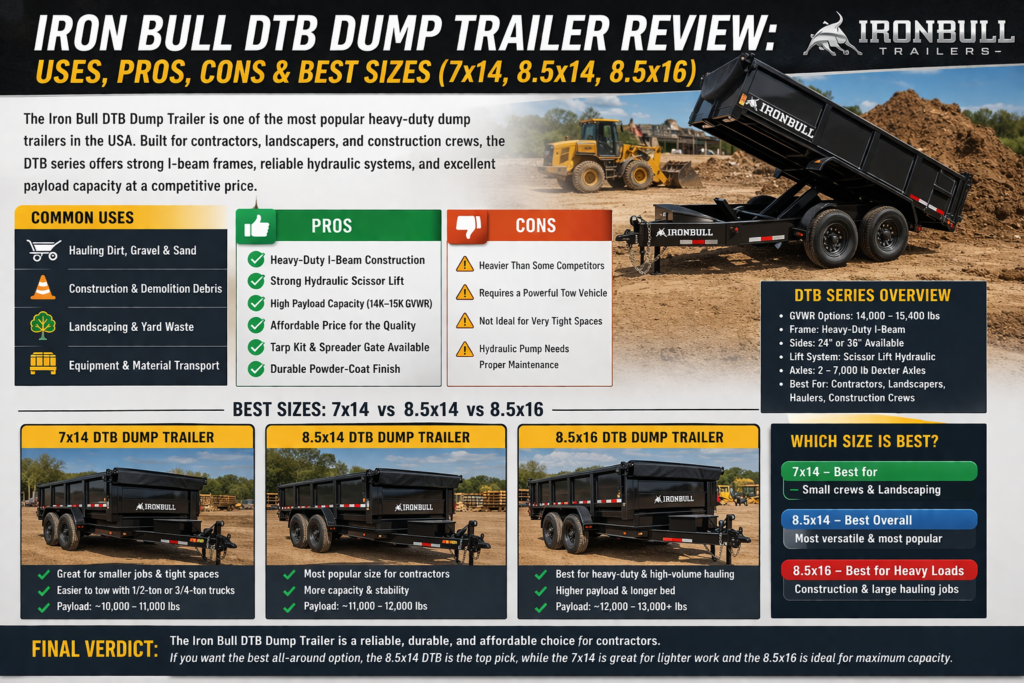
The Iron Bull trailers DTB dump is one of the most talked‑about medium‑ duty dump models in the Iron Bull lineup, especially the 14K GVWR DTB 7×14, DTB 8.5×14, and DTB 8.5×16 configurations. Built for contractors, landscapers, and small‑ to mid‑size hauling operations, the DTB series offers a no‑frills, heavy‑duty dump bed that’s straightforward to operate and easy to integrate into an existing fleet.
In this Iron Bull DTB dump trailer review, we’ll cover:
- Key uses and who it’s best for.
- Strengths and weaknesses of the DTB design.
- How the 7×14, 8.5×14, and 8.5×16 sizes differ in capacity and handling.
- Real‑world pros and cons and why you might or might not want to buy one.
If you’re comparing brands for your next 14K dump trailer, this review will help you decide whether the Iron Bull DTB dump is the right fit.
Who Uses an Iron Bull DTB Dump Trailer? (Uses & Applications)
The Iron Bull trailers is designed for a wide range of hauling jobs, mainly in construction, landscaping, roadwork, land clearing, and light municipal work.
Typical uses include:
- Hauling gravel, dirt, sand, and topsoil for landscaping and grading.
- Transporting small‑volume concrete, stone, and mulch for residential and light commercial jobs.
- Dumping debris, rock, and demolition materials around small job sites.
- School‑yard or park projects, fencing, and driveway work where you need a compact dump bed without a full‑size commercial dump unit.
The 14K GVWR of most DTB models makes them ideal for 1/2‑ton and 3/4‑ton pickups that can’t safely pull larger 21K or 22K dump trailers. The DTB 7×14 and 8.5 sizes strike a sweet spot between capacity, maneuverability, and ease of loading/unloading.
Iron Bull DTB 7×14: Size, Specs, and Use Case
The DTB 7×14 is the most popular and compact size in the DTB dump line and is often the first choice for contractors and landscapers starting in the dump business, upgrading from a utility trailer, or running solo jobs.
Typical DTB 7×14 features (review‑style summary):
- 7’ x 14’ dump bed with 14,000 lb GVWR, 2 x 7,000 lb axles, 3‑sided or 4‑sided sides, and a hydraulic or scissor‑style lift.
- Light‑duty 3’ to 4’ side height that’s great for softer materials like topsoil, dirt, and mulch, while still capable of handling gravel.
- Steel or rugged steel‑ composite body with a 12″–14″ I‑beam or channel‑style frame, depending on the year and options.
- Treated or steel bottom deck and reinforced tailgate for frequent dumping.
Pros of the DTB 7×14 in the field:
- Easy to tow with a 1/2‑ton pickup.
- Tight turning radius and parking ease for small properties and driveways.
- Lower overall cost than larger DTB 8.5 and 102‑inch models.
- Good for light‑ to medium‑duty jobs that don’t need 18K–22K GVWR.
Cons / Limitations:
- Limited cubic yard capacity versus 8.5‑ft‑wide and 102‑inch models.
- 14K GVWR means you must carefully manage loads if you’re towing close to max capacity.
- Fewer “heavy‑dump” options in base packages, although dealers can often add snowplow kits, high‑side kits, and extended hoist kits.
This size is ideal if you’re looking for an affordable, compact dump trailer that can handle a wide range of jobs without overloading your truck.
Iron Bull DTB 8.5×14: More Capacity, Same Agility
The Iron Bull trailers DTB 8.5×14 ups the bed width to 8.5 feet while keeping roughly the same 14K GVWR, giving you more cubic yards of material per load without dramatically changing the trailer’s length or towing profile.
Key points for DTB 8.5×14 (review focus):
- 8.5′ x 14′ bed with 14K GVWR, typically 2 x 7,000 lb axles and tandem 8‑ply tires (often 235/80R16).
- Slightly higher side heights (often 24″–28″) and reinforced bottom rails for gravel and heavier materials.
- Similar lift system to the 7×14 hydraulic or scissor‑style with the same basic controls and maintenance.
Where DTB 8.5×14 shines:
- Hauling gravel, stone, and base materials for driveways and road projects.
- Commercial landscaping work where you need more volume per load than a 7‑ft bed allows.
- Rental or fleet operations that want a versatile, mid‑size dump trailer for multiple clients.
Pros of DTB 8.5×14:
- Increased payload capacity (more material per load) without adding length.
- Still manageable with a 3/4‑ton pickup in most cases.
- Popular size with many dealers, making it easy to buy new or used.
Cons / Considerations:
- Slightly wider footprint, which can complicate tight residential driveways or narrow job sites.
- Slightly higher price than 7×14 models.
- Requires careful load‑distribution planning to stay within 14K GVWR when hauling heavy materials.
If you want more volume than a 7×14 without jumping to 102‑inch width, the DTB 8.5×14 is a strong mid‑step option.
Iron Bull DTB 8.5×16: Added Length for Heavier Jobs
The DTB 8.5×16 adds two extra feet of length compared to the 8.5×14, giving you even more material‑carrying capacity within the same 14K GVWR envelope. While it doesn’t increase GVWR significantly, the extra bed length makes it attractive for linear projects like road edges, pipe runs, or longer‑haul gravel jobs.
Review‑style highlights for DTB 8.5×16:
- 8.5′ x 16′ bed, 14K GVWR, 2 x 7,000 lb axles.
- Longer wheelbase and slightly different weight distribution than 14‑ft models.
- Same basic frame and dump system as 7×14 and 8.5×14, with incremental upgrades in side height and cross‑member count.
Best uses for DTB 8.5×16:
- Hauling long runs of gravel or crushed stone for roads, driveways, or pathways.
- Handling pipe, culvert, or long materials where you need extra bed length.
- Larger‑scale landscaping or construction sites where you want one trailer to cover more ground per trip.
Pros of DTB 8.5×16:
- More cubic yard capacity than 8.5×14 with similar width and GVWR.
- Good for “one‑stop‑fill” situations on linear projects.
- Still under the 102‑inch critical‑width threshold, making it relatively easy to license and insure.
Cons / Limitations:
- Longer length reduces maneuverability in tight spots.
- Slightly higher wind‑resistance and different braking/towing feel compared to 14‑ft models.
- Price is typically higher than 14‑ft variants.
Choose DTB 8.5×16 when you need extra length, not just extra width, and you’re comfortable with a longer bed.
Iron Bull DTB Dump Trailer: Overall Pros
This section steps back from sizes and gives an overall Iron Bull trailers DTB dump trailer review, highlighting what buyers consistently like:
Common pros mentioned in reviews and forum discussions:
- Rugged build quality for an entry‑ to mid‑level dump trailer.
- Clean, simple design that’s easy to maintain and repair.
- 14K GVWR that works well with common 1/2‑ton and 3/4‑ton pickups.
- Affordable price point compared to custom or heavy‑duty commercial dump brands.
- Wide availability through dealers, making it easy to buy new or used.
Iron Bull’s DTB series is known for no‑frills utility it’s built to haul, dump, and repeat, not to impress with luxury features.
Usuarios
Common cons mentioned in real‑world feedback include:
- Lower overall GVWR than 21K or 22K dump models, which can be limiting for large‑scale jobs. Limited upgrade options (hoist, snowplow, high‑side kits, etc.) compared to some Western brands.
- Basic wiring and control layout that may feel less “pro‑grade” than premium dump trailers.
- Steep learning curve for new owners who haven’t used dump trailers before.
These limitations are mostly about scale and features, not safety or reliability. With proper maintenance and sensible load management, the DTB dump is a solid choice.
How to Choose the Right DTB Size (Buyer’s Guidance)
For readers deciding whether to buy an Iron Bull trailers DTB 7×14, DTB 8.5×14, or DTB 8.5×16, the key factors are:
- Truck capacity and GVWR limits.
- Typical load materials (topsoil vs gravel vs stone).
- Job‑site access and turning radius.
- Budget and whether you want room to grow.
As a rule of thumb:
- DTB 7×14 is best for light‑duty or starter dump jobs.
- DTB 8.5×14 is best for mixed‑duty landscape, gravel, and light construction.
- DTB 8.5×16 is best for long‑run projects and heavier gravel/stone hauling.
If you’re still unsure, spending a day or two discussing options with an authorized Iron Bull dealer can help you match your towing setup and job types with the right DTB size.
Iron Bull DTB Dump vs Other Iron Bull Dump Models
For completeness, this review should briefly position DTB among other Iron Bull dump lines such as DTG, DWG, DDG, and DHG. The DTB series is generally the entry‑level 14K dump while DTG, DWG, etc., are heavier‑duty, often with 16K–22K GVWR and more advanced hoist options.
Buyers who want maximum GVWR, higher side heights, or 102‑inch width often move to DTG or DWG models. Those who want maximum value and simplicity at 14K GVWR often stay with DTB. The decision between DTB and other Iron Bull dump lines depends on your max payload, materials, and budget.
Final Verdict: Who Should Buy an Iron Bull DTB Dump Trailer?
After reviewing the DTB 7×14, 8.5×14, and 8.5×16, the DTB dump is best suited for:
- Contractors and landscapers needing a dependable 14K dump trailer for light‑ to medium‑duty work.
- Part‑time dump owners who want a relatively affordable, easy‑to‑use trailer.
- Small‑scale hauling operations where 14K GVWR is enough.
If you’re ready to buy or want to see available Iron Bull Trailers DTB 7×14, 8.5×14, or 8.5×16 in stock, consider browsing listings at your local Iron Bull dealer or major trailer seller. Many dealers offer live quotes and financing options, so you can compare current prices before committing.
Call‑to‑Action CTA:
Want an Iron Bull Trailers DTB dump trailer price quote or help choosing between DTB 7×14, 8.5×14, or 8.5×16? Call or email us today and our team can match you with the right DTB dump trailer for your truck and jobsite.
