
Iron Bull Trailers
How to Choose the Right Iron Bull Trailer Size and GVWR
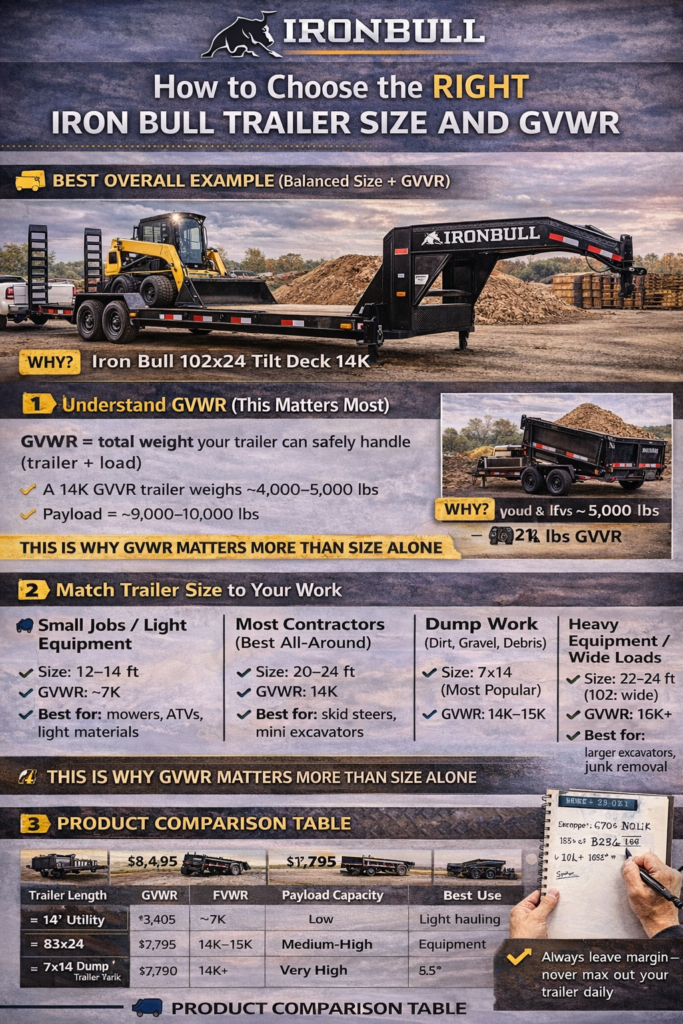
Apr
Introduction
The right iron bull trailers size and weight rating can make a huge difference in safety, performance, and day-to-day efficiency. An Iron Bull trailer that is too small may leave you short on payload and deck space, while one that is too large may cost more than you need and be harder to tow with your current truck.
That’s why it helps to understand the basics of Iron Bull GVWR charts, trailer widths, lengths, axle options, and common use cases before you buy. Whether you need a compact utility trailer, a 14K dump trailer, or a 21K gooseneck deckover, this guide will help you match the trailer to the job.
What GVWR Means
GVWR stands for Gross Vehicle Weight Rating, which is the maximum total weight a trailer is designed to carry, including the trailer itself plus cargo. In simple terms, GVWR tells you how much payload capacity you can safely use.
For Iron Bull buyers, this is one of the most important numbers to understand because it affects what you can haul, what truck you need, and which trailer model makes the most sense. A trailer with a higher GVWR usually has stronger axles, heavier frame construction, and more capability for demanding work.
Iron Bull Trailer Size Guide
When people search for an Iron Bull trailer size guide, they are usually trying to answer three questions:
- How wide should the trailer be?
- How long should the trailer be?
- What GVWR do I need for the loads I haul?
Iron Bull trailers are available in a range of widths and lengths depending on the model line. Smaller utility trailers may work well for lawn equipment, supplies, and light hauling, while wider deckover and gooseneck models are built for tractors, skid steers, mini excavators, lumber, pallets, and heavier commercial loads.
A good rule is to choose the smallest trailer that still gives you enough room and capacity, because that helps keep costs, towing complexity, and empty weight under control.
Iron Bull 10K vs 14K vs 21K
One of the most common buying decisions is whether to choose a 10K, 14K, or 21K Iron Bull trailer. Each rating fits a different kind of buyer.
10K trailers
10K trailers are a strong choice for lighter equipment hauling, compact tractors, smaller utility work, and general-purpose use. They are often easier to tow and may be a better fit for buyers who do not need a large payload every day.
14K trailers
14K trailers are one of the most popular Iron Bull categories because they offer a strong balance of price, capacity, and towability. Many dump trailers, equipment trailers, and deckover models fall into this range, making them a practical step up for contractors and landscapers.
21K trailers
21K trailers are built for serious hauling and are usually the best choice when you need more payload, more stability, or more room for larger equipment. These trailers are often found in gooseneck and deckover configurations and are ideal for heavier commercial jobs.
If you are unsure, start by estimating your heaviest common load, then choose the trailer category that gives you some cushion above that number.
Choosing the Right Width
Trailer width matters just as much as GVWR. A narrower trailer may be easier to tow and store, but a wider trailer can handle larger equipment and improve loading flexibility.
Iron Bull trailers commonly come in 83-inch width and 102-inch width configurations.
- 83-inch trailers are a versatile fit for many dump and utility applications.
- 102-inch trailers are better for wider equipment, deckover use, and gooseneck hauling where maximum deck space matters.
If you haul skid steers, small tractors, pallets, or larger attachments, a 102-inch Iron Bull trailer may be worth the upgrade.
Choosing the Right Length
Length affects both load capacity and load balance. A longer trailer gives you more room for equipment and material, but it can also increase empty weight and change how the trailer tracks behind your truck.
Iron Bull trailers often run from shorter 12-foot utility models up through 20-, 22-, 24-, 26-, 30-, and even 32-foot equipment or deckover models depending on the series. The best length depends on what you haul most often.
- 12’–14′: better for light utility work and compact hauling.
- 16’–18′: good for small equipment and general contractor use.
- 20’–22′: strong all-around lengths for dump and equipment trailers.
- 24’–32′: better for larger equipment, deckover hauling, and commercial work.
The goal is to avoid buying more length than you need, while still leaving room for safe loading and weight distribution.
Matching Trailer to Use
Iron Bull offers different trailer styles, and the right size depends on how you plan to use it.
Utility trailers
Best for lawn equipment, small tools, mulch, light materials, and general property maintenance. These usually have lower GVWR ratings and are simple to tow.
Dump trailers
Best for gravel, dirt, debris, firewood, demolition waste, and landscaping materials. Dump trailers are a strong choice when you need easy unloading and frequent material movement.
Equipment trailers
Best for skid steers, tractors, generators, compact machinery, and contractor hauling. Equipment trailers often include ramps, higher capacity axles, and stronger frame construction.
Deckover and gooseneck trailers
Best for larger equipment, oversized loads, and heavy commercial hauling. These are the models buyers usually consider when they need maximum deck space and stronger towing stability.
How to Avoid Buying Too Small
A trailer that is undersized can create problems fast. If the GVWR is too low, you may overload the trailer, wear out components faster, and reduce safety. If the deck is too short, you may not be able to balance the load properly. If the width is too narrow, larger equipment may not fit safely.
That is why the right buying process starts with your actual work. Ask yourself:
- What is the heaviest item I haul regularly?
- What is the widest item I need to carry?
- Do I need a dump, utility, equipment, or gooseneck model?
- What truck will I use to tow it?
Answering those questions first usually points you toward the right Iron Bull size and GVWR much faster than just shopping by price.
How to Avoid Buying Too Large
Buying too much trailer can be just as inefficient as buying too little. A larger trailer may cost more, weigh more, and require a more capable truck. It can also be harder to maneuver in tight job sites or residential driveways.
If your work is mostly light landscaping, property maintenance, or small utility hauling, a compact Iron Bull trailer may be the smarter choice. The best trailer is the one that handles your real workload without excess size or expense.
Which Iron Bull Trailer Should You Choose?
Here’s a simple way to think about it:
- Choose 10K if you need a smaller, more affordable trailer for lighter hauling.
- Choose 14K if you want the most versatile all-around trailer size and weight rating.
- Choose 21K if you haul heavy equipment, larger materials, or need a gooseneck/deckover setup.
In many cases, the 14K class is the sweet spot for buyers who want a mix of value and capability. The 21K models are better when your work regularly pushes the limits of standard equipment trailers.
Final Buying Tip
If you are comparing Iron Bull trailers, start with the load weight, then move to GVWR, then choose width and length, and finally decide between dump, equipment, utility, deckover, bumper-pull, or gooseneck. That order helps you shop smarter and avoid overspending on the wrong trailer.
If you want the easiest path forward, use this guide as your starting point and then compare live inventory by trailer class, size, and weight rating to find the best match for your job.
If you want, I can also turn this into:
- a more dealer-focused version with stronger sales CTAs,
- a shorter blog version for quick publishing,
- or a full HTML-ready post with title tags and H2/H3 formatting.
