
Iron Bull Trailers
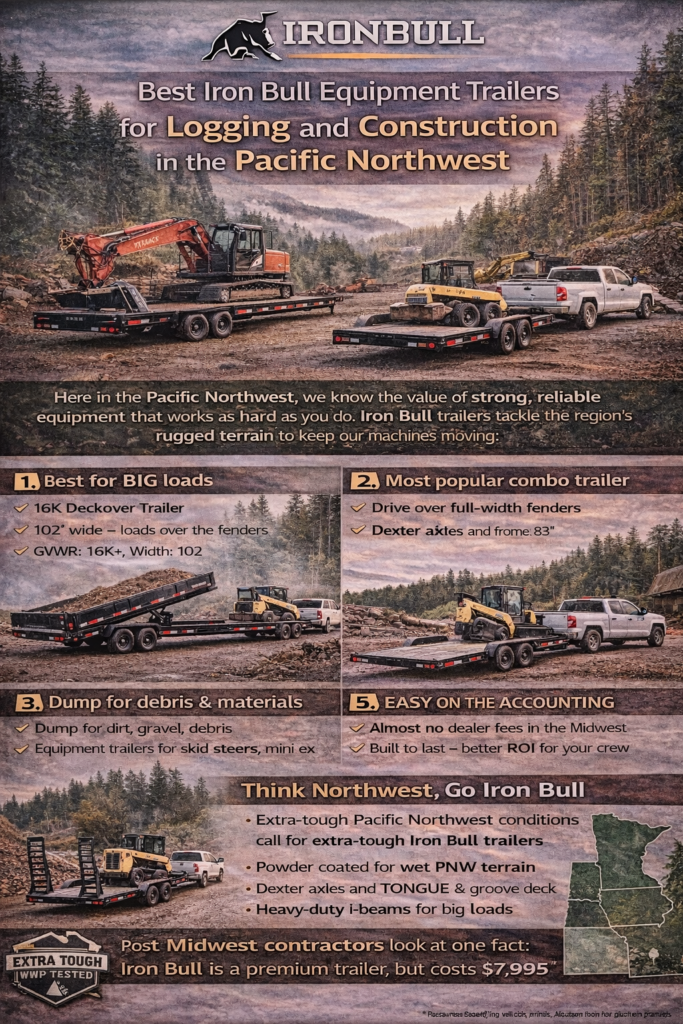
Best Iron Bull Equipment Trailers for Logging and Construction in the Pacific Northwest
Apr
When you’re hauling heavy equipment through the rugged logging roads and construction sites of the Pacific Northwest, having the right trailer isn’t a luxury it’s a requirement. The Iron Bull equipment trailer logging line delivers the kind of brute‑strength build, 102” width, and serious GVWR that Pacific Northwest contractors and loggers have come to expect from their trailers.
Why Iron Bull Equipment Trailers Work So Well in the Pacific Northwest
The Pacific Northwest’s combination of steep grades, wet weather, soft ground, and oversized equipment loads demands a trailer that doesn’t just survive jobsites it thrives on them.
Iron Bull equipment trailers meet that need with:
- Heavy‑duty I‑beam and 12″–14″ beam frames that resist twisting on uneven logging roads.
- High GVWR options (14K–22K) suited for skid‑steers, excavators, mowers, and log‑hauling accessories.
- 83″ and 102″ wide decks that provide stability when transporting gear across narrow forest‑service roads.
- Low‑maintenance components (LED lighting, treated‑wood or steel floors, and robust axles) that stand up to rain, mud, and long‑haul freeway runs.
For contractors in Oregon, Washington, Idaho, and Western Montana, Iron Bull equipment trailers are often the default choice when safety, payload, and durability all need to be perfect.
Iron Bull Equipment Trailers Best Suited for Logging
Logging requires a trailer that can handle heavy, uneven loads, frequent moving, and rough, off‑pavement conditions often with minimal room for error. Several Iron Bull equipment‑trailer lines excel in logging‑tribal, private land, and contract‑logger operations.
Iron Bull ETB / EWB Series – Accessible Logging Support Trailers
The Iron Bull ETB and EWB bumper‑pull equipment trailers are ideal for smaller logging crews that need to move skid‑steers, mowers, log‑grapple attachments, and basic equipment from one site to the next.
- GVWR: 10K–16K depending on size and configuration
- Width: 83″ or 102″
- Best for:
- Moving skid‑steer‑mounted log grapples between cutting blocks
- Transporting firewood, brush‑mowers, and small excavators
- Contractors who need easy, 1/2‑ton–compatible towing without going full‑gooseneck
These models shine when you need flexible, lower‑cost hauling for logging support gear without committing to a 102‑gooseneck yet.
Iron Bull THG 22 – Super‑Single 10K Gooseneck Tilt for Heavy Log Haul Support
The Iron Bull THG 22 10K gooseneck tilt‑deck trailer is a powerhouse for heavy‑equipment support in logging and rough‑terrain construction. Though it’s not a full‑log‑haul semi trailer, it’s perfect for:
- Hauling large skid‑steers, mowers, and track‑hoes in and out of remote sites
- Supporting fire‑management contractors who move dozers and brush‑rakes
- Contractors in the Cascades, Oregon timber belt, and Washington timber regions who need a low‑profile, 102‑wide trailer with hydraulic tilt for easy loading
Its super‑single 10K axles, ramp‑style tilt, and 16″ crossmembers are built for the kind of punishing use logging contractors see in the PNW.
Iron Bull FLG 22 – Low‑Pro 102 Deckover Gooseneck for Heavy Construction & Logging Support
The Iron Bull FLG 22 low‑pro deckover gooseneck plays a central role in Pacific Northwest construction and logging support fleets. With 102″ width and 22,000 lb GVWR, the FLG 22 is capable of carrying:
- Large skid‑steers and compact track loaders
- Small excavators and log‑handling attachments
- Construction equipment, tools, and even small utility machines for camp or road‑building jobs
In the PNW, contractors use FLG 22s for:
- Forest‑road construction and maintenance
- Fire‑line equipment movement
- Seasonal logging support and brush‑clearing jobs
The 102 FLG’s low deck height and full‑width ramps make it easy to load and unload in tight, uneven spaces exactly what you need in the Northwest’s rugged landscape.
Best Iron Bull Trailers for Construction in Oregon and Washington
For Iron Bull trailer for construction work, the Pacific Northwest’s mix of urban‑growth corridors, rural infrastructure projects, and challenging terrain demands trailers that can handle everything from concrete work to road grading.
Iron Bull ETG – Gooseneck Equipment Trailers for Mixed‑Use Construction
The Iron Bull ETG line of gooseneck equipment trailers gives contractors a 102‑wide, high‑GVWR platform for hauling generators, lighters, small excavators, and material stacks. In the Pacific Northwest, ETG‑style trailers are used for:
- Hauling dirt and small equipment for site prep
- Transporting trench‑ing and grading tools
- Supporting paving and utility crews who need equipment on‑site fast
Iron Bull equipment trailers logging crews also use ETG‑style builds to move trenchers, mini‑excavators, and support tools across forest‑service‑gravel roads.
Iron Bull 102 Equipment Trailer – The Go‑To Choice for PNW Contractors
When people in Oregon talk about an Iron Bull 102 equipment trailer, they’re usually picturing a 102‑wide, 21K–22K gooseneck hauling multiple skid‑steers or a full‑size excavator across I‑5, I‑84, or the mountain passes.
Key reasons PNW contractors love the 102 equipment trailer:
- Extra deck width helps distribute weight more evenly over rough terrain.
- 102” width improves stability on wet, slick, and angled logging‑road shoulders.
- Higher GVWR matches the needs of mixed‑use hauling (equipment, tools, and materials) on a single trailer.
Ask any long‑haul logging or construction outfit in Oregon, Washington, or Idaho, and you’ll likely see a 102 Iron Bull equipment trailer in their yard.
Iron Bull ETB / TWB – Bumper‑Pull Trailers for Smaller PNW Jobsites
Not every job needs a 102‑gooseneck. The Iron Bull ETB and TWB bumper‑pull equipment trailers are ideal for:
- Local‑area concrete and landscaping crews
- Subcontractors supporting larger construction projects
- Ranchers and small‑timber landowners who need versatile hauling
These trailers pair well with 1/2‑ton and 3/4‑ton pickups, making them a cost‑effective “workhorse” for everyday hauling without the full‑weight commitment of a gooseneck.
Iron Bull Equipment Trailer Logging: Matching Trailers to Your Job
If you’re asking “Which Iron Bull equipment trailer is best for logging?”, the answer depends on how heavy your loads are and how remote your sites are.
For light‑to‑moderate logging support (skid‑steers, mowers, grapples):
- Go with Iron Bull ETB/EWB 10K–16K bumper‑pull for flexibility and easy towing.
For heavy‑equipment logging support (large skid‑steers, small excavators, dozers, bladed‑items):
- Choose Iron Bull THG 22 or Iron Bull FLG 22 102 gooseneck for maximum GVWR and stability.
For mixed‑use construction and logging on the same property or project:
- The Iron Bull 102 equipment trailer (FLG, ETG, or THG) offers the best balance of payload and versatility.
Locals in Oregon and Washington often pair a bumper‑pull Iron Bull (ETB, EWB, or utility) with a 102‑gooseneck for a two‑trailer setup: one for light, frequent hauls; one for heavy, infrequent moves.
How Pacific Northwest Terrain and Climate Shape Your Iron Bull Choice
The Pacific Northwest’s climate and geography matter when choosing an Iron Bull equipment trailer:
- Rain and mud demand strong, rust‑resistant components, proper lighting, and good tire clearance.
- Steep grades and forest‑service roads reward gooseneck setups with better weight distribution and higher GVWR.
- Coastal maritime climate and inland snow zones mean you need trailers built for corrosion resistance and long‑term exposure to salt, ash, and road grime.
For all of these reasons, many Iron Bull equipment trailer logging and construction fleets in the PNW are moving toward:
- 102‑wide gooseneck builds (FLG, THG, ETG)
- 16K–22K GVWR options
- Low‑maintenance, LED‑lit, treated‑wood or steel‑floor builds
Iron Bull Equipment Trailers in Oregon: From Timber to Trailers
In Oregon, the conversation around Iron Bull trailer Oregon usually centers on:
- Timber‑country haulers who need durable, stable trailers for moving equipment between cut‑blocks.
- Public‑works and utility contractors who haul heavy equipment over winding county roads.
- Landscaping and construction companies in the Willamette Valley who need reliable support trailers for concrete and grading work.
For Oregon crews, the Iron Bull 102 equipment trailer and Iron Bull THG/FLG series are often the default picks for serious hauling, while ETB and EWB bumper‑pulls handle lighter, everyday jobs.
Iron Bull Equipment Trailer Logging: Protective Features to Look For
When choosing an Iron Bull equipment trailer logging build, look for:
- Full‑beam or 16″ crossmember construction for maximum frame rigidity
- 102‑wide decks for better side‑to‑side stability on uneven logging‑road shoulders
- Full‑width or 8‑foot ramps for easy loading in tight spaces
- DOT‑approved LED lighting and molded sealed wiring harnesses for reliability in wet conditions
- 10K–22K axles depending on whether you’re hauling skid‑steers, mowers, or small excavators
These features keep your trailer running longer and safer in the Pacific Northwest’s demanding conditions.
Conclusion: Picking the Right Iron Bull Equipment Trailer for PNW Jobsites
For Iron Bull trailer for construction work and Iron Bull equipment trailer logging operations alike, the Pacific Northwest demands a balance of strength, stability, and practicality.
- Choose Iron Bull ETB/EWB for flexible, lower‑GVWR work on smaller jobs.
- Go with Iron Bull THG 22 or FLG 22 when you need a 102‑gooseneck built for heavy‑equipment hauling and rough terrain.
- Opt for an Iron Bull 102 equipment trailer when you want maximum deck space and GVWR for mixed‑use logging and construction support.
Whether you’re in Oregon, Washington, or nearby PNW states, the right Iron Bull equipment trailer can make the difference between moving smoothly from job to job and spending time repairing or recovering.
Call to Action
If you’re searching for “Iron Bull trailer Oregon” or “Iron Bull equipment trailer logging near me,” reach out to a local Iron Bull or Norstar dealer in the Pacific Northwest. They can help you match your logging or construction work to the exact Iron Bull equipment trailer whether it’s an ETB, EWB, THG, FLG, or ETG that’s built for Pacific Northwest terrain and PNW‑sized loads.
