
Iron Bull Trailers
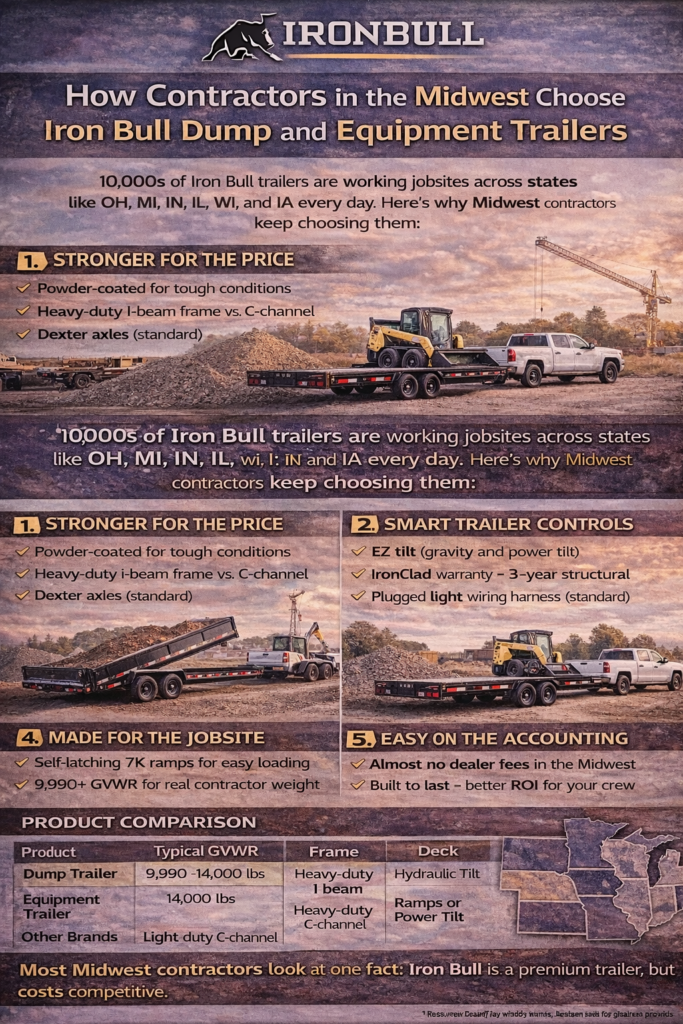
How Contractors in the Midwest Choose Iron Bull Dump and Equipment Trailers
Apr
The Midwest is a hub for construction, farming, landscaping, roadwork, and utility projects, all of which demand reliable trailer partners. With long hauls, muddy fields, gravel pads, and winter conditions, Midwest contractors need trailers that can handle the grind without breaking the bank. Iron Bull dump and equipment trailers have become a common sight on job sites from Iowa to Indiana, Missouri to Minnesota, and there’s a clear pattern behind how local crews choose models that fit their workload, truck, and operating budget.
In this post, we’ll break down the real‑world selection process used by Midwest contractors, the most popular Iron Bull models in the region, and how local dealers help them choose, buy, maintain, and upgrade their Iron Bull trailers over time.
Why Midwest Contractors Prefer Iron Bull Trailers
Many Midwest contractors start with general questions like:
- “Do I need a dump or an equipment trailer?”
- “Can my 1/2‑ton or 3/4‑ton truck safely tow this Iron Bull model?”
- “Will it last through winter, gravel pads, and heavy materials?”
Iron Bull enters the conversation here because it offers:
- Heavy‑duty frames (angle, I‑beam, and channel‑flange builds) that resist deformation and fatigue.
- A broad GVWR range (7K, 14K, 16K, 21K, 22K) that matches various truck capacities.
- Affordable pricing compared to some premium brands, especially in dump and landscape utility configurations.
For contractors in the Midwest, where gravel, dirt, concrete, storm‑clean‑up, and ongoing site development are common, Iron Bull’s DTB, DTG, DWG, UTB, and 102 equipment trailers fit naturally into day‑to‑day operations.
Most Common Uses: Midwest Construction & Landscaping Jobs
To understand how Midwest contractors choose Iron Bull, it helps to see how they use Iron Bull:
- Concrete, grading, and excavating crews often run Iron Bull 7×14 DTB or 7×16 DTG dump trailers, hauling rock, gravel, and fill straight to forms or pads.
- Landscapers and site‑prep crews favor Iron Bull 7×14/7×16 dump trailers for topsoil, mulch, sod, and small rocks; many also pair an Iron Bull equipment trailer (ETB, EWB, or 102) to haul skid‑steers, mini‑excavators, or mowers.
- Farmers and rural contractors commonly use Iron Bull dump trailers for animal feed, manure, and field grading, plus Iron Bull utility and equipment trailers for moving machinery around large properties.
In short, the Midwest favors compact‑to‑midsize dump trailers (DTB, DTG, DWG) and straight or 102‑wide equipment trailers that balance GVWR, loading ease, and maneuverability in tight rural or suburban job sites.
Iron Bull Dump Trailers: DTB, DTG, DWG, and Deckover Options
Iron Bull’s dump line gives Midwest contractors clear choices between light‑, mid‑, and heavy‑duty dump configurations.
- Iron Bull DTB 7×14 (14K dump)
- Why contractors choose it:
- Affordable, entry‑level dump with 14K GVWR.
- Fits smaller pickups and can handle topsoil, gravel, and moderate concrete loads.
- Common in landscaping, bunk‑maintenance, and small‑scale construction.
- Why contractors choose it:
- Iron Bull DTG 7×16 / 8×16 (14K–18K dump)
- Why contractors choose it:
- Extra length and often higher GVWR (16K–18K) for heavier loads and longer hauls.
- Popular for commercial landscaping, road‑side grading, and municipal work.
- Why contractors choose it:
- Iron Bull DWG / Deckover Dump & Equipment Trailers
- Why contractors choose them:
- Ability to haul both materials and small equipment on the same trailer.
- Low‑profile deckover builds like FLG‑style 102 equipment trailers are popular when contractors need to clear more ground or carry a loader plus materials.
- Why contractors choose them:
By mapping these models to specific job types (landscaping vs. heavy‑equipment hauling vs. farm use), Midwest contractors can quickly narrow down which Iron Bull dump or dump‑style trailer suits their primary workload.
Iron Bull Equipment Trailers: ETB, EWB, UTB, and 102 Gooseneck Trailers
For contractors who haul skid‑steers, mini‑excavators, mowers, generators, and tools, Iron Bull equipment trailers are critical.
- Iron Bull UTB / UTB03 / UTB07 Utility Trailers
- Why Midwest contractors choose them:
- Inexpensive, no‑frills utility hauling for lawnmowers, brush, and small equipment.
- 3.5K–7K GVWR options match common 1/2‑ton and light 3/4‑ton pickups.
- Why Midwest contractors choose them:
- Iron Bull ETB / EWB Bumper‑Pull Equipment Trailers
- Why contractors choose them:
- 10,000–21,000 lb GVWR options with ramps or flat decks.
- Easy to tow with many standard pickup trucks.
- Why contractors choose them:
- Iron Bull 102 Equipment Trailers (Gooseneck and Tandem Axle)
- Why contractors choose them:
- 102” width for large equipment and uneven loads.
- Higher GVWR (up to 21K–22K) and often gooseneck configurations for improved stability.
- Why contractors choose them:
When Midwest contractors compare Iron Bull UTB (utility), ETB/EWB (equipment), and 102 gooseneck options, they’re usually trading off cost, GVWR, and maneuverability a decision that local dealers help them walk through in person.
How Midwest Contractors Match GVWR, Truck Size, and Terrain
Midwest contractors don’t just pick a trailer because it “looks good”; they align GVWR, truck capacity, and terrain to avoid overloading, sway, and breakdowns.
- Step 1: Check truck towing capacity
- Many contractors in the Midwest run 1/2‑ton or 3/4‑ton pickups; Iron Bull 7×14 DTB, DTG, and UTB models are often chosen because they fit comfortably within these limits.
- Step 2: Factor in terrain
- In flat Midwest corn‑belt areas, contractors can safely run closer to max GVWR.
- In hilly or rocky terrain, Midwest crews often downsize to a slightly lower GVWR model or choose a tandem 14K+ deckover for better stability.
- Step 3: Decide on dump vs equipment
- “Do I haul mostly materials?” → Pick an Iron Bull dump trailer (DTB, DTG, DWG).
- “Do I haul more machines and tools?” → Pick an Iron Bull equipment or 102 trailer (ETB, EWB, UTB, FLG, THG).
This GVWR‑matching process is something dealers walk Midwest contractors through on the lot, and it’s a key reason many contractors in the region feel confident in their Iron Bull selection.
Regional Case‑Study Snapshots: How Midwest Contractors Actually Choose
To bring this to life, here are a few real‑world‑style case studies of how Midwest contractors choose Iron Bull:
- Case 1: Small Landscaping Crew (Illinois suburb)
- Needs: Haul topsoil, mulch, and a 1‑ton skid‑steer.
- Choice: Iron Bull 7×14 DTB dump for materials and an Iron Bull ETB 83 x 20 equipment trailer for the skid‑steer.
- Why they picked Iron Bull: Affordability, dealer‑owned service, and strong local parts support.
- Case 2: Rural Roadwork Contractor (Iowa)
- Needs: Gravel, base rock, and small excavator transport.
- Choice: Iron Bull 7×16 DTG 16K dump trailer and a tandem 102 equipment trailer for the excavator.
- Why they picked Iron Bull: Rugged frame, consistent GVWR ratings, and availability at regional dealers.
- Case 3: Farm‑Based Contractor (Northern Indiana)
- Needs: Animal feed delivery, field grading, and loader hauling.
- Choice: Iron Bull 7×14 DTB for materials and an Iron Bull UTB07 utility trailer for lighter tasks.
- Why they picked Iron Bull: Simple, durable builds and cost‑effective long‑term ownership.
These snapshot‑style stories help illustrate how contractors naturally gravitate toward specific Iron Bull lines once they assess their job mix.
The Role of Local Dealers in Midwest Iron Bull Selection
Local dealers are a huge part of why “Iron Bull trailer contractor Midwest” and “Iron Bull trailer for construction Midwest” are strong regional keywords. Midwest contractors rely on dealers for:
- In‑person inspections of Iron Bull dump and equipment trailers (checking frame quality, rust, brakes, and ramp condition).
- Demonstration loads so contractors can see how an Iron Bull DTB 7×14 or ETB 102 behaves when fully loaded.
- Financing, trade‑in, and service bundles that make buying Iron Bull more affordable than going direct.
How to Choose the Right Iron Bull Model for Your Midwest Job
If you’re a contractor in the Midwest, here’s a quick decision‑making flow that mirrors what local dealers often recommend:
- Decide: dump or equipment?
- Mostly materials → Iron Bull dump (DTB, DTG, DWG).
- Mostly machines → Iron Bull equipment (ETB, EWB, 102, UTB, UTB07).
- Match GVWR to your truck
- 1/2‑ton pickup → DTB 7×14, DTG 7×16, or UTB models.
- 3/4‑ton or heavy‑duty → DTG 8×16, DWG, or 102‑width trailers.
- Consider your terrain and loads
- Flat, long‑haul routes → higher GVWR options are usually fine.
- Hilly, rough, or muddy conditions → favor deckover, 102 width, or gooseneck stability.
- Talk to your local dealer
- Ask about inventory, lead time, financing, and service for your preferred Iron Bull configuration.
By following this flow, Midwest contractors can turn the broad search term “Iron Bull trailer contractor Midwest” into a concrete buying path.
Conclusion: Iron Bull Trailers Fit the Midwest Contractor’s Needs
For contractors in the Midwest, Iron Bull dump and equipment trailers offer a smart combination of ruggedness, value, and regional dealer support. Whether you’re hauling concrete in a small town in Illinois, clearing ditches in Iowa, or grading rural driveways in Missouri, the right Iron Bull dump or equipment trailer can become a cornerstone of your hauling operation.
If you’re ready to explore Iron Bull trailer options for construction or landscaping in the Midwest, use nearby dealer inventory pages, compare popular models like the DTB 7×14, DTG 7×16, ETB 102, and UTB07, and then schedule a test tow or visit to see how each Iron Bull trailer performs under your typical loads.
CTA:
Want help choosing the right Iron Bull trailer for your Midwest job site? Fill out our contact form or call your local dealer to walk through Iron Bull dump and equipment options tailored to your truck and workload.
